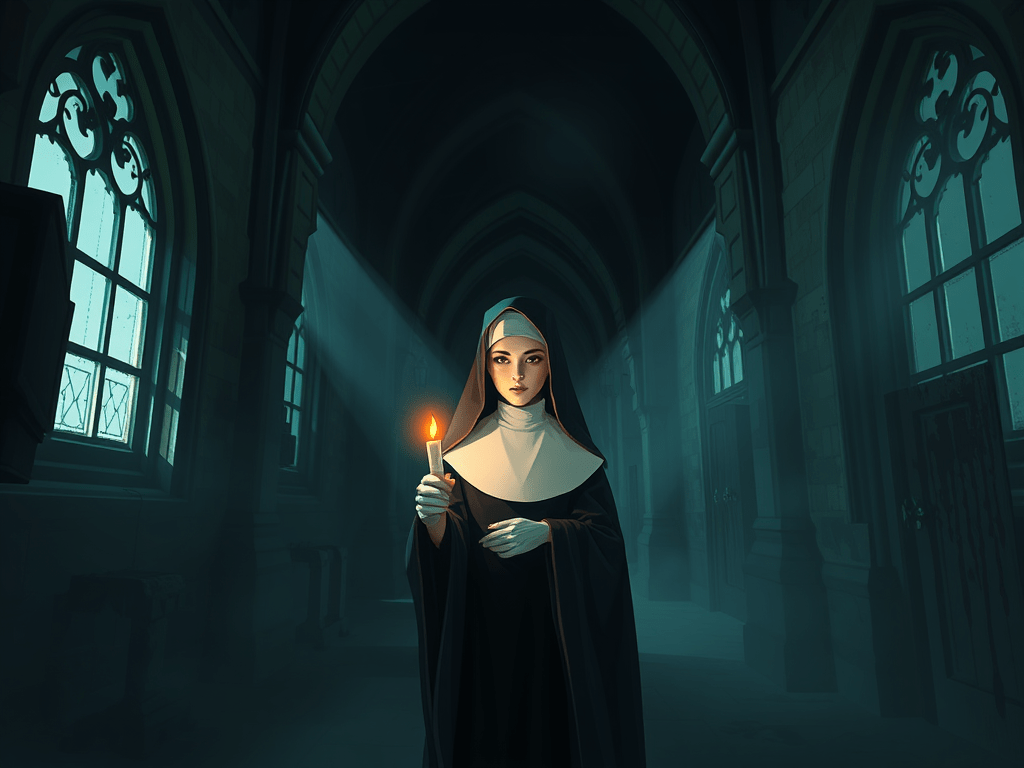
I did not set out to build a cathedral like this. The Widow’s Bramble Cathedral emerged slowly, almost against my will, as a place shaped by fear rather than faith. Every room felt like it was pushing back, as if the structure itself remembered the moment people fled and never came back. Thunder became part of its language. Survivors began appearing in corners I had not planned for. A nun stepped out of the darkness holding a candle, not as a symbol of hope, but as proof that someone was still trying to believe. The mayor’s voice, the boarded windows, the blood-streaked doors, all of it felt less like design and more like uncovering something that was already there. By the time I reached the bell tower, with bats screaming and the old bell trembling in the wind, I realized I was no longer writing a safe place. I was writing a place where faith had failed, and people were still paying the price for it.
The Rot-Hushed Riverwalk came next, and it was quieter, but in many ways more honest. This stretch was about exhaustion, about land that had seen too much and no longer cared who passed through it. I kept imagining old PC games I played late at night, wandering across landscapes that felt lonely rather than hostile, places where danger was implied instead of shouted. The strange lights in the water, the fisherman watching without explanation, the quicksand that punished hesitation, all of it came from that feeling of wandering too far from home and realizing no one was coming to guide you back. I wanted the river to feel like memory itself, smooth in places, rotten in others, always pulling forward. Even when the path climbs and the view opens up, there is no triumph there, only distance, and the quiet realization that you have crossed something you cannot uncross.
The Mouth of the Pale Mother was harder to write than I expected. This section demanded commitment. There is no spectacle here, no dramatic reveal that makes you feel clever for finding it. Instead, it closes around you slowly. Narrow ledges, hanging doors, forgotten maps, rooms left exactly as they were when everything stopped. Writing the soldier bound to the chair was the moment I had to pause, because it felt like crossing a line, not for shock, but for honesty. This place is not evil because it is loud. It is terrifying because it is patient. The deeper I went, the more the walls felt like a throat, the lantern weaker, the sense of self thinner. When I wrote the elevator at the end, descending into darkness with no promise of return, I knew it mattered that the player could not simply walk away. Some parts of the Labyrinth are not meant to be escaped easily, because neither are the thoughts that lead you there.
I am sharing this not as a feature list or a content update, but as a confession. This game is still being built room by room, late at night, guided by memory, fear, curiosity, and a love for the kind of games that trusted the player to feel something without being told what to feel. If you are still here, still walking these paths with me, I am grateful in a way that is difficult to express cleanly. This Labyrinth exists because you are willing to step into it. And for now, that is enough.


Leave a comment