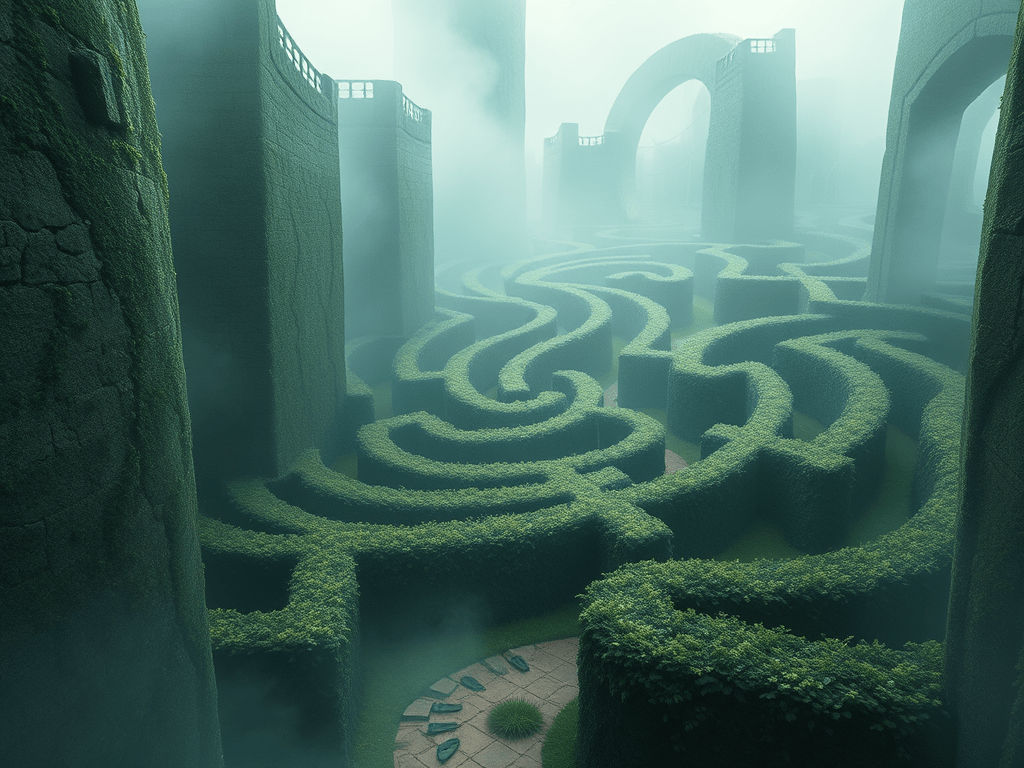
There has always been something honest about a maze. From the earliest days of text adventures, mazes were never designed to be kind. They existed to slow the player down, to test patience, and to force engagement in a way few other mechanics could. With limited memory and no graphics to lean on, designers relied on repetition, subtle wording, and player imagination to create spaces that felt vast, confusing, and alive.
Few games captured this better than Colossal Cave Adventure. That game did not just introduce players to exploration, it introduced them to uncertainty. You stepped forward without knowing what waited beyond the next command. The maze sections in particular were not simply obstacles. They were moments where the game stopped holding your hand entirely. Directions blurred together. Descriptions repeated. The world stopped reassuring you that progress was being made. And that was thrilling.
The tension came from not knowing if you were moving toward something meaningful or walking deeper into confusion. Every choice carried weight because there was no guarantee of clarity on the other side. You had to trust your instincts, your notes, and sometimes your stubbornness.
Getting lost was not failure. It was participation. These mazes demanded attention. Players mapped by hand, questioned their own assumptions, and slowly learned how the space behaved. The maze became less about solving and more about understanding. When you finally found your way through, the reward was not spectacle. It was relief, earned quietly, and felt deeply. That kind of tension is rare now. Modern games often fear losing the player. Early text adventures trusted the player instead. They trusted curiosity. They trusted patience. They trusted that the unknown itself was enough to keep someone going.
I have always liked a good maze for that reason. It does not rush you. It does not explain itself. It invites doubt and rewards persistence. A good maze mirrors real thought, rarely straight, often looping, and sometimes uncomfortable. If a maze finds its way into the future of my work, it will not be there as a trick or a joke. It will exist as a space where the player must slow down, listen closely, and accept not knowing for a while. The tension of the unknown is not something to be avoided. It is something to be experienced. The long way through has always been the most memorable one.
 The Ventureweaver
Leave a comment