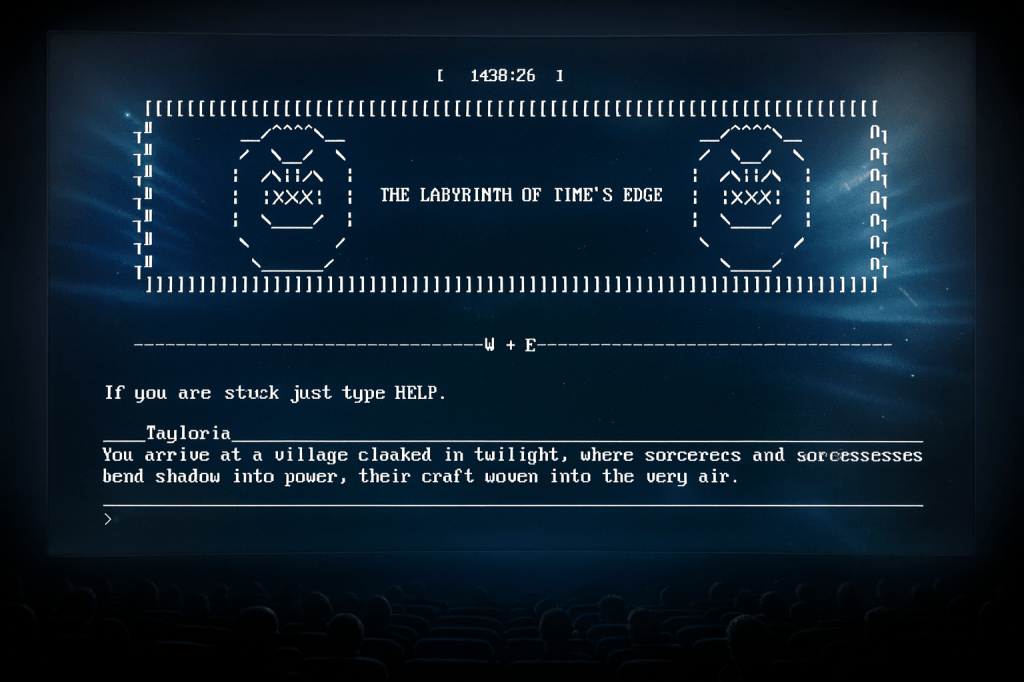
The Dream That Refused to Die
If you grew up when games came on floppies and manuals smelled like ink and adventure, you remember that first spark, when imagination did the rendering, and every word on a black screen felt like the start of something eternal.
That spark never died. It’s here, alive, glowing faintly beneath the dust of forgotten hardware. It’s called The Labyrinth of Time’s Edge, a QBasic text adventure that’s not just reviving an era, it’s expanding it.
Over 4,000 handcrafted rooms, written line by line, coded in the language of the past, and stitched together by one simple philosophy:
“Imagination will always outlive graphics.”
This is The Free QBasic Game You Need to Experience Now – Part II.
A sequel not in form, but in fire.
The Dungeon Awakens
Where the first article celebrated the concept, the miracle that something like this exists, this one takes you inside. Deep below The Castle at the Edge of Time, into the first dungeon floors that define the soul of this project.
It begins humbly:
“Before you looms the grand entrance to a dungeon forsaken by the light of God. Here, only the wicked remain…” [Room 4045]
These early floors aren’t just environments, they’re acts of resurrection. Every description, from chains swaying gently from the walls to the executioner waiting motionless in the torchlight, is designed to echo the text adventures of the 1980s: Zork, Colossal Cave, The Lurking Horror. But where those games left off, The Labyrinth dares to continue.
When you descend the spiral stairs into Dungeon Floor Two, the air grows heavy, the sound of cheering turns to screams, and the ghosts of a thousand lines of QBasic begin to whisper again.
Retro as Resistance
It’s easy to dismiss retro games as nostalgia. But The Labyrinth of Time’s Edge isn’t nostalgic. it’s defiant.
It refuses to modernize, to streamline, to conform.
There’s no flashy UI, no endless patches, no microtransactions.
There’s just you, your imagination, and the void.
This game doesn’t beg for your attention; it earns it.
By forcing you to read, to listen, to see without seeing.
QBasic wasn’t supposed to do this. It was supposed to fade away, like floppy drives and CRT monitors. But here, it has become a vessel for something sacred, the last untouched corner of interactive storytelling. A place where text still holds the power of creation.
The Castle’s Depths: A Journey Through Damnation
The early floors tell a story older than time itself: a fall from grace, a descent into sin, and the quiet persistence of the human spirit.
On Dungeon Floor One, you meet the EXECUTIONER, still clutching his axe in eternal pause, his role unclear, his fate certain. You walk among pyramids of skulls, tread upon a carpet of bones, and hear your name whispered by the dark. These are not levels; they are psalms of ruin.
By Dungeon Floor Two, the cruelty becomes ritual. GUARDS raise their hands in rapture before unholy spectacles. MURLUHS, monstrous hybrids, tear at each other in blood-soaked pits. And all the while, faint music plays, a requiem for humanity’s last dignity.
Each line of text is hand-forged, not for efficiency but for emotion. Every corridor breathes. Every death feels earned.
A Cathedral of Shadows
Then comes the fourth and fifth floors, where the dungeon stops pretending to be a structure and becomes a presence.
You encounter an OLD MAN, eyes wide with disbelief after centuries of solitude. You pass STATUES frozen in screams, GHOSTS that recognize your soul, and a woman dressed in black beating drums for the dead.
The writing here isn’t just descriptive, it’s liturgical. It reads like scripture from another dimension.
“Torches flicker wildly as the drumming grows faster, pulling you into another place or perhaps another time entirely.” [Room 4117]
“A woman dressed in black, standing upon a platform, her face hidden as she beats the rhythm of the dead.” [Room 4118]
It’s a sermon written in ASCII. A cathedral built from code.
And when you finally reach the fifth floor, you understand what this project is:
Not a game.
Not a story.
But a monument to the art of worldbuilding through words.
The Return of the Forgotten Medium
The Labyrinth of Time’s Edge exists to remind us that the earliest games weren’t limited, they were limitless. Text adventures weren’t about what you could see. They were about what your mind could imagine. In the era of billion-dollar budgets, this QBasic epic feels almost rebellious. It’s not polished for algorithms or optimized for dopamine hits. It’s rough, raw, real, coded in a language older than some of the players who will discover it.
But make no mistake, it is alive.
And it is growing.
Every month, more rooms appear. More mysteries are written. More echoes of lost worlds are unearthed by a single creator working late into the night, fueled by coffee, nostalgia, and purpose.
Why You Should Play It Now
Because this is gaming history, still being written. Because someone, somewhere, decided that imagination was worth saving. Because this isn’t just retro, it’s rebellion through creation.
You don’t need a high-end PC. You don’t need 4K textures or 120 FPS.
All you need is curiosity, patience, and a willingness to dream again.
Inside these rooms, the past and future of storytelling meet. You can feel the hum of the old world in every line of code, the warmth of cathode glow behind every flickering torch, and the heartbeat of a generation that believed words could build worlds.
And they still can.
Join the Descent
If you’ve ever wanted to experience what it feels like to truly play with your imagination, this is the moment. Download the game. Explore the depths. Walk where the executioners stand, where the ghosts remember, where the torches flicker in rhythm with your heartbeat.
The Castle is waiting.
🎮 Play the Game (Free): thelabyrinthoftimesedge.com
💾 Download it on Itch.io: the-ventureweaver.itch.io/tlote4111
📺 Watch Devlogs and Behind-the-Scenes: YouTube.com/@TheVentureweaver
🕯️ Support the Creation of Future Floors: Patreon.com/TheVentureweaver
“It’s not about escaping the dungeon. It’s about remembering that the dungeon was never meant to end.”
– The Ventureweaver
 The Ventureweaver
Leave a comment