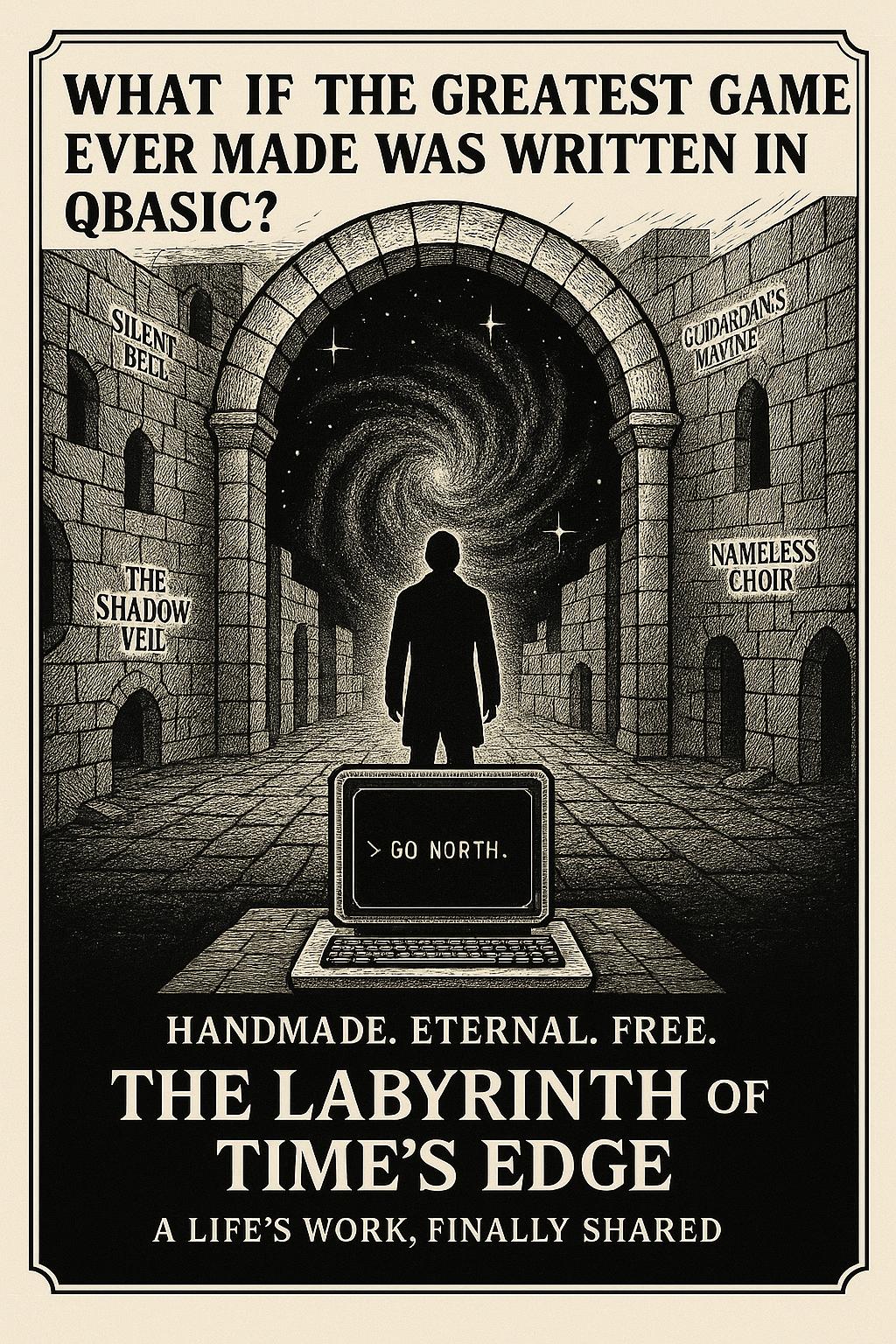
A Testament to Imagination, Perseverance, and the Rebirth of True Gaming
The Origin
In an age where games are mass-produced, algorithm-tuned, and profit-optimized, The Labyrinth of Time’s Edge stands defiantly a monument to a different era. A hand-forged era. An era where worlds were built line by line, where players explored not for points or dopamine loops, but for wonder, mystery, and meaning.
This is not a product. This is a pilgrimage.
The origin of The Labyrinth of Time’s Edge begins over thirty years ago, when a young creator armed with only a keyboard, curiosity, and a passion for storytelling began to shape what would become a lifelong project. Inspired by the golden age of interactive fiction, games like Zork, A Mind Forever Voyaging, and the dusty text adventures of Infocom, this wasn’t just a hobby. It was a vision one that would grow, evolve, and carry the emotional weight of decades.
Over the years, technology changed. Engines came and went. Studios rose and collapsed. But the game endured writing entirely in QBasic, a language long abandoned by the gaming mainstream. Every mechanic, every command parser, every interaction system was custom-built. No engines, no frameworks, no shortcuts. Just raw, deliberate code.
But The Labyrinth of Time’s Edge isn’t just defined by its technical backbone. It is a living world one that has grown room by room, echoing the mind and soul of its creator. As of today, the game boasts over 2,400 interconnected rooms, each with its own tone, purpose, and place in the grand architecture of the labyrinth. No two are the same. And none are random.
Behind every description is memory. Behind every name is intention.
This is a world shaped not by deadlines or design documents, but by dreams. The result? A game that is not just played, but felt where players do not simply click through objectives, but walk the edge of time itself, unraveling a narrative that unfolds like a long-lost myth finally being remembered.
The Vision
At the heart of The Labyrinth of Time’s Edge lies a vision untainted by the demands of monetization, deadlines, or industry trends. This is not a game that tries to be everything for everyone. This is a game built on a single promise:
That wonder still exists, and it’s waiting for those brave enough to find it.
While the modern gaming industry marches toward homogenization, where every new release is a variation of the last, layered with microtransactions, daily login bonuses, and “content roadmaps,” The Labyrinth of Time’s Edge does something radical. It stops. It breathes. It asks the player to slow down. To listen. To read. To become part of a world not made to entertain them, but to challenge them, to stir something ancient and aching within.
This is a game that doesn’t hold your hand. It trusts you.
It trusts that you can walk into a room described only in a few evocative sentences and feel the wind on your face. It trusts that you can decipher symbols, remember names, and make decisions not based on flashy prompts but on intuition and curiosity. There are no checkpoints, no tutorials, no arrows on the ground. The Labyrinth doesn’t care about your gamer score.
What it offers instead is something sacred: immersion born from silence.
Because this game believes in its players. It believes in their intelligence. Their patience. Their hunger to explore. And for those who accept its invitation, The Labyrinth of Time’s Edge becomes more than a game. It becomes a mirror.
It reflects who you are in the choices you make. It reflects your courage in how far you dare to go. And it reflects your soul in what you carry with you once the journey ends or continues, as it always does.
In a world of shortcuts, The Labyrinth is a long road. And that’s exactly why it matters.
The World
The world of The Labyrinth of Time’s Edge is unlike anything built in modern gaming. This isn’t a map it’s a memory palace. A living, breathing archive of forgotten emotions, fractured timelines, and broken histories waiting to be pieced together. From the first step, the player is immersed in a realm not just vast in scale, but deep in spirit.
Each region, each room, is more than a location. It’s a moment suspended in time, described with care and precision to evoke mood and story with minimal words and maximal resonance.
You might begin your journey beneath a weathered sky, in the ruins of a village long since abandoned. Cracked lanterns hang from rusted poles. Footsteps echo where no one walks. And always, always, the wind whispers things you were never meant to hear.
And then the world begins to open.
The Silent Bell
One of the most iconic and emotionally charged locations in the game, the Silent Bell is not just a place, it’s a memory. A monument to grief, silence, and something you’ve lost but can’t name. Players who step into the area feel the tone shift: the air gets heavier, the text more poetic, the pace slower. Every object is deliberate. Every sound (or lack thereof) is a choice. You don’t just explore it. You remember it.
The Shadow Veil
Far more surreal, the Shadow Veil bends the rules of reality. After stepping through a forgotten veil fold crafted by long-dead dream wrights, you emerge in a realm stitched together from broken time and subconscious thought. Colors bleed. Paths double back. Figures appear where none should be. It’s a part of the game that challenges perception, not just navigation. And it rewards those who feel their way forward, not just those who analyze.
The Iron Hold, the Withered Orchard, and the Temple of Viremyr
These regions are not there to “check boxes” for environments. The Iron Hold groans with the weight of industry and the memory of labor long abandoned. The Withered Orchard is a natural graveyard of beauty and decay. The Temple of Viremyr holds the sacred, the ancient, and the eerie all in one breath. These places aren’t just settings. They teach you something about the world, and about yourself.
As players explore, a map begins to form not just on paper, but in their minds. And that’s the genius of this world. You don’t just remember what’s north or west, you remember how it felt. You remember the way the words made you feel. That’s the sign of the real world. A true world.
A world with an edge.
The Mechanics
If the soul of The Labyrinth of Time’s Edge is its world, then its beating heart is the mechanics, not flashy, not fast, but crafted with intentionality, precision, and respect for the player’s intellect.
Built entirely in QBasic, the game eschews modern engines, middleware, and pre-packaged systems. Instead, everything, every line of code, every parser response, every inventory interaction is hand-written. There is no graphical interface. No mouse clicks. No mini map. And that’s exactly the point.
You interact with the world through typed commands. Simple, direct phrases like:
- LOOK AT MIRROR
- TALK TO PRIEST
- TAKE KEY
- SLEEP IN BED
- GO NORTH
This system isn’t a gimmick it’s a design philosophy. By forcing the player to engage with language, the game slows them down, draws them in, and transforms gameplay into a kind of ritual. You’re not just pressing buttons you’re thinking in prose. You’re writing the story as you go.
And the system goes deeper. Many rooms contain NPCs and interactive items, each with their own behaviors, dialogue trees, and story arcs. Some may offer cryptic insights. Others may weep silently, say nothing, and disappear when you return. This unpredictability isn’t random, it’s emotional architecture. It creates a sense of mystery and presence, making every room a new question.
The save and load system is robust, allowing for long-form exploration across a sprawling game world. You might play for hours and barely uncover a fraction of the map. There’s no breadcrumb trail to follow only your wits, your notes, and your growing intuition.
And then there’s the map itself: over 2,400 rooms, each hand-mapped and positioned in a massive web of interconnected paths, backroads, and dream corridors. There are entire areas hidden behind riddles, lies, or the trust of a ghost. And some doors only open if you dare to ask the right question.
The mechanics don’t just support the story, they are the story. Every command typed is a step forward, a piece of trust given. And the game never takes that lightly.
In a world of instant gratification and handholding, The Labyrinth of Time’s Edge remains definitely analog. A machine built from memory. A ritual built from code.
The Lore
Beneath the winding tunnels and ruined chambers of The Labyrinth of Time’s Edge lies something deeper than puzzles or geography: a mythos. Not handed to you. Not explained in a flashy cinematic. But felt, discovered, pieced together like broken stained glass.
The lore of the game is organic, not dumped into a codex, but woven into the world like ivy through stone. It’s in the names of places, the faded words etched into walls, the way certain entities respond to your presence. It’s in the silence between dialogue lines, the unanswered questions that seem to grow in importance the longer they remain unresolved.
The Order of Dreamwrights
Long before the player’s arrival, there were those known as Dream wrights mystics who believed that space and memory were bound together. They created veil folds, hidden doors between reality and thought, sealed by symbols and songs long forgotten. They’re gone now or so it seems. But their fingerprints linger in the geometry of the Shadow Veil, in the unnatural bends of certain rooms, in the strange way time folds in on itself in some areas.
The Nameless Choir
Deep beneath the known world lies a series of catacombs where songs echo with no source. This is the home or grave of the Nameless Choir, a collective of souls who once tried to trap divine truth in harmonic frequency. They failed. Or maybe they succeeded too well. The result is a place where sound takes shape and memory has weight, where even silence feels alive.
Entities, Echoes, and the Forgotten
Throughout the Labyrinth are beings that defy categorization. Some appear as former humans, broken by time. Others are echoed ghosts who do not know they’re dead, repeating their last thoughts like scratched records. Some creatures watch. Some speak. Some only weep. And still others respond to your presence in ways you don’t understand yet.
There is no glossary for this world. There is no canon wiki. The lore lives only where it was meant to live in the minds of those who explore, who listen, and who remember.
The Labyrinth of Time’s Edge is not here to answer all your questions. It’s here to give you better ones.
The Silent Bell
Among the vast and varied regions of The Labyrinth of Time’s Edge, few leave as lasting a mark on the player as The Silent Bell. This is not a level. It is not a dungeon. It is a memory crafted not just from text, but from silence, emotion, and the aching feeling of something left unresolved.
You don’t enter the Silent Bell. You drift into it.
The air changes. The descriptions shift in tone. Gone are the concrete certainties of walls and doors. Instead, you walk through a place that feels suspended in sorrow. The Silent Bell doesn’t toll. It hasn’t for a long time. And that absence of silence rings louder than any sound ever could.
The ground here is littered with forgotten tokens: a cracked child’s toy, a book with pages torn out, a lantern that won’t stay lit. There are benches where no one sits anymore, a chapel where the dust clings too tightly, and a tower with a great bell that never chimes. You begin to ask yourself: what happened here?
But there are no cutscenes. No exposition dumps. Just fragments.
You may meet a mourner, seated silently in a pew, unable to speak without breaking down. A ghost child, who doesn’t recognize you but is clearly waiting for someone. A caretaker, who continues sweeping the chapel floor, unaware that no one comes here anymore. They don’t offer clues. They offer grief.
The genius of this place lies in its restraint. It never tells you how to feel. It simply surrounds you with the remnants of something deeply lost. And in doing so, it becomes a reflection of your own unspoken griefs, your own regrets, your own silent bells.
It’s a place many players return to, even when they don’t need to. Just to sit in the stillness. Just to remember.
Because in a game filled with time travel, memory loops, and fractured realities, The Silent Bell is not broken it is waiting. Waiting to be heard again. Waiting for the right player to listen. And perhaps to forgive.
This area alone proves that The Labyrinth of Time’s Edge is more than a game. It is a vessel for emotional storytelling. The kind that stays with you long after you type QUIT.
The Shadow Veil
Beyond the memory-soaked quiet of the Silent Bell lies something different. Something older, stranger. Something that doesn’t just question time but wounds it.
This is The Shadow Veil a realm that slips beneath the waking world like a second skin. You do not find it on the map. You find it between thoughts, beneath memory, through a veil fold carved by the Dreamwrights long before this age. A shimmering fracture in space built not from stone or magic, but from silence, recollection, and dreams unspoken.
The Veil is not a single place; it’s a condition. A state of being. And as you pass through it, the game begins to change. Commands feel different. Directions blur. North might no longer mean “north.” You begin to question not just where you are, but who you are and whether you’ve been here before.
In this realm, geography bends to emotion. Rooms loop endlessly unless you move with purpose. Statues cry without reason. Strange creatures, hunched and twisted, lurk behind shifting walls of smoke and stone. Some whisper. Others imitate the voices of people you’ve met long ago. Or maybe haven’t.
Rooms That Remember
Many of the Veil’s rooms are not just described, they respond. Some are dream reconstructions of places you’ve already been, now corrupted or blurred. Others are new, but feel hauntingly familiar, like places from your own past somehow woven into the code. It’s a feedback loop of player and game. Your decisions leave imprints, and the Veil reflects them back at you in strange and beautiful ways.
Moraff and the Archive
Among the most pivotal NPCs here is Moraff, a former keeper of the Archives memory nexus buried deep within the Veil. He greets you as though he’s been waiting, though he doesn’t remember why. His words are cryptic, tired, almost relieved to finally see you. Through him, you learn of the Archive: a structure that doesn’t store information, but experiences, choices, fragments of the past. Some of yours. Some not.
The Archive Itself
When you reach it, you’re not greeted by data or text but by visions. Frozen tableaus. Replays of moments from earlier in the game, now altered. Voices that should be gone. Rooms that bleed into each other. A strange sense that you’ve been living inside someone else’s memory all along.
The Shadow Veil is a turning point. For many players, it’s where the game stops being a journey and becomes a meditation. On loss. On identity. On the lies we tell ourselves to move forward. It’s the kind of space that shouldn’t exist in a text adventure and yet, here it is. Daring to be both narrative and mirror.
Once you leave the Shadow Veil, things are not the same. And neither are you.
Design by Hand
The Labyrinth of Time’s Edge is not just a game, it’s an act of rebellion.
Every word you read, every room you enter, every entity you meet was crafted by hand. Not generated. Not copied. Not prompted into existence. Built. Typed. Rewritten. Thought over. Loved. And in a digital age increasingly overrun by automation and synthetic content, that makes this game not just rare but sacred.
While modern development pipelines have become obsessed with efficiency, The Labyrinth of Time’s Edge stands as a deliberate monument to inefficiency. To care. To slow creation. And in that slowness is where the magic happens.
You can feel it in the descriptions. Not a single line is filler. No room exists just to “take up space.” Every stone has a story. Every whisper in the wind has a weight. This is not procedural generation, it’s poetic intention.
Because when something is built by hand, it carries the fingerprints of its maker. And when you play this game, those fingerprints are everywhere:
- In the quiet emotional cadence of the room text.
- In the way the map loops, not for gameplay challenge, but for thematic resonance.
- In the items that serve no mechanical purpose but tell you everything about the world.
- In the NPCs who don’t reward you, but haunt you.
The creator behind this labyrinth, the Ventureweaver has spent decades shaping it. Not for money. Not for fame. But for meaning. For preservation. For the love of storytelling and the belief that games should be art, not product.
And that effort shows.
There is a weight to the writing, a density of feeling that no AI can replicate. Because what you’re exploring is not just a world. It’s a lifetime. You are walking through someone’s legacy, room by room, dream by dream.
In a time when people are asking, “Can’t we just generate games now?”, The Labyrinth of Time’s Edge answers with a quiet, powerful “No.” And thank God for that.
The Future
While many games reach a point of completion and close their gates, The Labyrinth of Time’s Edge is still growing. Still evolving. Because it was never meant to end. It was built to breathe.
With over 2,400 rooms already crafted by hand, the journey continues driven not by deadlines or launch windows, but by a singular force: the dream of building the greatest text adventure of all time. A world that never stops expanding. A story that never stops unfolding. A labyrinth with no center only layers.
What Comes Next
New Regions
The future of the game includes entire new maps, such as:
- The Clockwound Spire – A haunted tower lost in time, filled with moving gears, chains, and the echoes of fallen timekeepers.
- The Catacombs of the Nameless Choir – A deeply buried song-prison where memory and melody merge into ritualistic madness.
- The Hollow Mercy – A sanctuary twisted by war, half-church, half-grave, where faith lingers like rot in the walls.
- The Guardian’s Landing – A strange celestial dock where otherworldly beings once communed with mortals under starless skies.
Each of these areas will bring new lore, new mechanics, new challenges and new chances for players to lose themselves in something unforgettable.
Deeper Systems
Plans are underway for refining the game’s internal systems: memory mechanics that affect which characters remember you, items that evolve as you use them, and veiled routes that unlock based on spiritual intent, not just logic.
The player’s choices will begin to ripple outward in more visible ways. Rooms will react. Echoes will shift. And the labyrinth itself may begin to watch back.
Patreon, Preservation, and the Push for Full-Time Creation
But to truly realize this vision to expand this universe without compromise the creator needs something that modern success too often withholds: freedom.
The dream is to make The Labyrinth of Time’s Edge not just a passion, but a full-time endeavor. To devote every hour to building, refining, writing, and protecting the integrity of a project that has defied all odds. That dream lives in community support on platforms like Patreon, through word of mouth, and from every player who believes that games can still be art.
This is not just development. It is resistance. Resistance against a culture that says things must be fast, loud, and shallow. The Labyrinth of Time’s Edge is quiet. It is slow. And it is eternal.
A Call to Arms
If you’ve read this far, then something has already awakened inside you.
Maybe it’s a memory of the first time a game truly moved you not with graphics or spectacle, but with words. Maybe it’s the longing for a world that feels handmade, unshackled from the machinery of monetization. Or maybe it’s the realization that something has been missing in modern gaming and that The Labyrinth of Time’s Edge is where that missing piece still lives.
This game is not for everyone.
It will not chase you with quests. It will not flatter you with explosions. It will not breadcrumb you into false achievement. What it will do is invite you to wander, to wonder, to remember who you were before the world told you what fun was supposed to look like.
And that invitation is rare.
We live in a time when creative voices are being drowned out by noise. When algorithms decide what you see. When genuine, personal artistry is replaced by content. And still, this time impossible, beautiful, stubborn game stands here, whispering:
“Come see what one soul can build, if they never give up.”
But the Ventureweaver cannot do it alone.
This project needs support not pity, not charity, but allies. Players. Patrons. Champions of the strange. If you believe in this kind of work, share it. Play it. Talk about it. Join the Patreon. Tell others why it matters. Help keep the fire alive not just for this game, but for the idea that games can still be sacred.
The Labyrinth of Time’s Edge is not finished.
It was never meant to be. Because stories like this don’t end they echo. They grow. They change with every new player, every new memory left behind. This is not just a game. This is a world. And now, it’s yours to explore.
So step forward.
And take your first step toward the edge of time.
 The Ventureweaver
Leave a comment