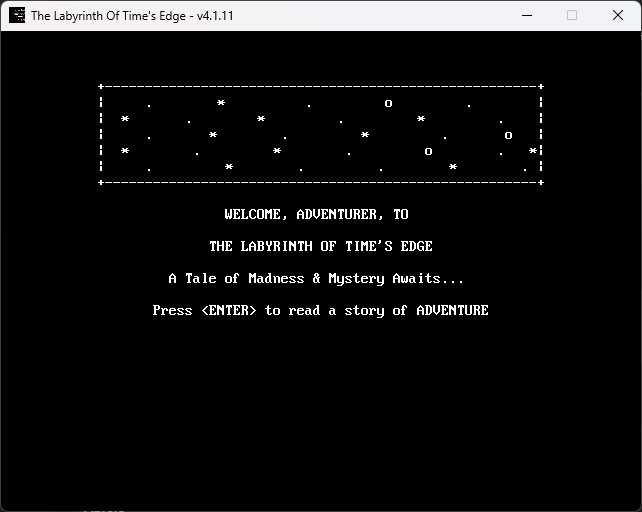
There are easier ways to make a game than writing thousands of lines in QBasic.
There are engines with drag-and-drop interfaces, AI-assisted code, glossy textures, and prefab terrain. There are tools designed to churn out content, to follow formulas, to satisfy trends. I could’ve taken that path, but I didn’t. Not because I’m nostalgic for old tech, but because I believe something far deeper:
That a game can speak without shouting.
That words alone can carry you to other worlds.
That a blinking cursor, properly wielded, can light a fire in the soul.
I built The Labyrinth of Time’s Edge not to fit into today’s gaming market, but to stand defiantly apart from it. This isn’t a live-service, loot-box-laden dopamine slot machine. This is my rebellion. A game not powered by profit, but by purpose. A handcrafted world where everything-every room, every whisper, every choice-was placed with care. Because care is what’s missing from so many games today.
Look at the industry titans, the so-called Big Three. With billion-dollar budgets and global teams, they create sprawling epics that too often feel empty. Flashy, yes. Technically impressive, sure. But behind the particle effects and Hollywood voice actors, where’s the heart? These games are engineered to hook you, to monetize you, to keep you spinning the wheel, not to move you. And yet, we cheer. We applaud. We preorder. We congratulate the machine for providing us with another cinematic spectacle while quietly draining our time and wallets.
I wanted something else. So I built it myself.
At the core of this world is TXTCORE: The Adventure Framework, my custom text-based engine written in QBasic. But it’s more than code. TXTCORE is my philosophy, my canvas, my chisel. It forces limits, and in those limits I find liberation. Because there’s no room for filler, no space for bloated mechanics, only words. Only story. Only intent.
No part of this framework is flash. It’s all flame.
Nowhere is that flame brighter than in the Village of Dremlith, one of the most atmospheric regions in the game. And I say “region” cautiously, because Dremlith is more than just a setting. It’s a state of mind. You don’t arrive there, you awaken in it. The moment you type LOOK, something changes. The silence draws close. The room descriptions don’t just inform, they haunt. They breathe. They remember.
You’re not just wandering through a ghost town. You’re walking through the echoes of what used to be: A schoolhouse still lit by candles no one remembers lighting. Perfumed trees that smell like forgotten memories. Graves that open not to scare, but to remind.
Each room in Dremlith is crafted like a stanza in a poem. One of my favorites reads simply:
The odd trees stand still along the way. A strange perfume wafts from them. A scent that doesn’t belong.
That’s not just environmental flavor, it’s a warning. A clue. A feeling. Something waits in those trees, not a monster, but an idea. That’s the heart of TXTCORE: it invites you to engage, not just react. To interpret. To wonder.
In modern engines, Dremlith would be coated in dynamic lighting and bloom. But in TXTCORE, the silence does the rendering. It leaves space for your fear, your imagination, your memory. And in that space, meaning lives. You’ll meet characters like Isenra, who sits quietly under the stars, beside a fire, offering no quest. She’s not an objective marker. She’s a presence, someone you feel, not solve. And in that quiet presence, something truly rare happens: you connect. Not with gameplay, but with story. With the world. With her.
Dremlith isn’t a level. It’s a spell. And TXTCORE? It’s the grimoire that lets it breathe.
I poured years into this world because I believe this kind of game, the one that asks you to slow down, to read, to feel, is worth saving. The Labyrinth of Time’s Edge may not trend. It may not explode on Twitch. But it matters. It matters to me. And I believe it will matter to you, too.
So if you’ve ever felt like today’s games are loud but hollow…
If you’ve longed for a world that trusts you to explore without reward pop-ups…
If you’ve ever missed the kind of storytelling that lingers after the screen fades…
Then light your lantern.
And welcome to Dremlith.
Because no one builds games like this anymore.
But someone remembered how.
 The Ventureweaver
Leave a comment